
CXCL9 in HLH
CXCL9 and IFNγ
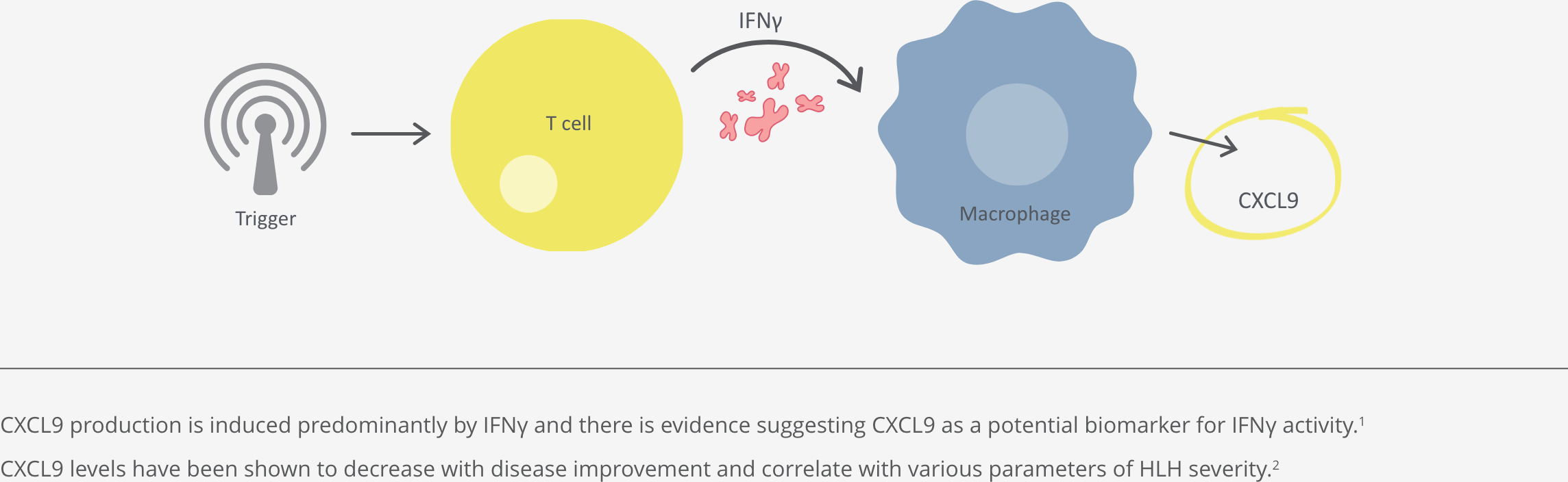
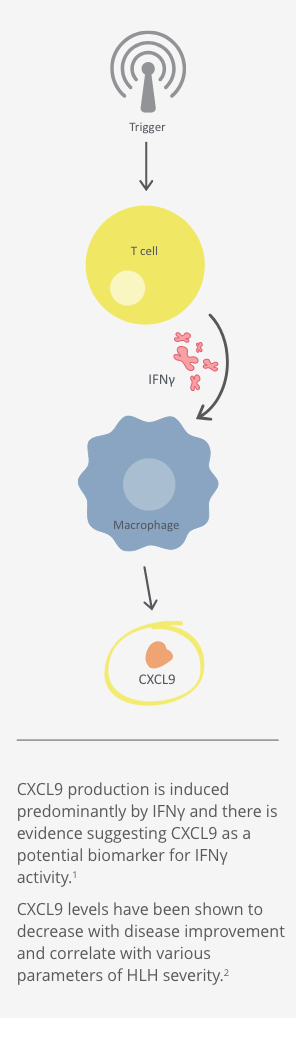
CXCL9 is a chemokine (a type of cytokine) released almost exclusively by IFNγ-activated macrophages. The primary function of CXCL9 is to attract T cells into inflamed tissues.1
CXCL9: making IFNγ measurable
Interferon gamma (IFNγ) plays a central role in driving hyperinflammation in HLH. However, IFNγ itself can be difficult to measure reliably in clinical practice.2
CXCL9 is a downstream chemokine induced almost exclusively by IFNγ, making it a useful surrogate marker of IFNγ activity. By providing a stable and measurable signal of IFNγ-driven immune activation in the blood, CXCL9 helps translate underlying disease biology into clinically meaningful information.2,3
IFNγ pathway activation → CXCL9 production → Clinical insight
CXCL9: A more biologically precise marker
Traditional inflammatory markers such as ferritin, CRP, and LDH reflect broad immune activation and can increase across a wide range of conditions. They may indicate general inflammation, infection, or tissue damage, but they have limited ability to distinguish underlying inflammatory drivers.4

CXCL9 adds a more biologically precise signal of IFNγ-driven pathology to existing clinical assessments.2
CXCL9 and disease severity in HLH
Emerging evidence suggests that CXCL9 may provide insight into the severity of IFNγ-driven hyperinflammation in patients with HLH.3
Because CXCL9 reflects activation of a core disease-driving pathway, elevated levels have been associated with more severe disease and poorer clinical outcomes. Studies have also demonstrated relationships between CXCL9 levels, disease activity, and overall clinical trajectory.3
Monitoring disease activity and hyperinflammation
In addition to helping characterize the underlying inflammatory state, CXCL9 may provide valuable information when assessing disease burden and monitoring changes over time. Serial measurement can offer a dynamic view of IFNγ-driven inflammation and may help identify patients with persistent or worsening hyperinflammatory activity.3
However, there is currently no universally accepted CXCL9 cutoff for diagnosis, risk stratification, or management guidance. Results should always be interpreted within the broader clinical context and alongside standard laboratory markers.3
CXCL9 can help identify high-risk patients early by reflecting the intensity and trajectory of IFNγ-driven hyperinflammation.3
A retrospective study:
CXCL9 as a novel prognostic marker to identify high-risk adults with hemophagocytic lymphohistiocytosis
A retrospective, multicenter chart review was conducted to broadly evaluate potential clinical biomarkers, including CXCL9, to determine which combination of markers provides the greatest prognostic utility in a large cohort of individuals undergoing clinical HLH evaluation.
CXCL9 emerged as the only optimal predictor of inpatient mortality among all markers assessed, with risk increasing as CXCL9 levels rose.3
Key findings for clinical practice3
The authors reported that CXCL9, a surrogate marker for IFNγ, served as a novel and consistent clinical laboratory marker in the identification and prognosis of adults presenting with HLH.*
Elevated CXCL9 levels were associated with early mortality in HLH+ patients

Strength of association and mortality risk
In patients with HLH, CXCL9 emerged as the only optimal prognostic marker of inpatient mortality across all evaluated labs, with elevated levels significantly associated with early mortality.3

Increasing risk
Higher baseline CXCL9 levels were associated with progressively higher mortality risk, further supporting the strength of its prognostic utility.3

Decreased levels in survivors
Among patients with serial measurements, significant decreases in CXCL9 levels were observed more frequently in 90-day survivors.3
Study limitations: Retrospective design may be impacted by unrecognized confounders. Restricted to patients ≥15 years, limiting generalizability to younger populations. Variability in HLH recognition timing across patients and centers may introduce selection bias. Sensitivity analyses were conducted to mitigate bias.
Inclusion criteria: Hospitalized patients ≥15 years undergoing HLH evaluation with ≥1 clinically validated CXCL9 test from a Clinical Laboratory Improvement Amendments (CLIA)-certified lab were included. Patients were excluded if CXCL9 testing occurred after initiation of HLH-directed therapy.
Patient characteristics: 171 adult patients were included and categorized as HLH- or HLH+. HLH+ was defined as meeting ≥4/8 HLH-2004 criteria and/or an HScore ≥169. Of 126 HLH+ patients, 73 met ≥5/8 HLH-2004 criteria.*
*Patients in the HLH+ cohort met at least 4 out of 8 HLH-2004 criteria and/or had an HScore ≥169. A cutoff of 4 out of 8 HLH-2004 criteria was used to capture a broad population including early HLH presentations and/or similar IFNγ-driven hyperinflammatory syndromes of which HLH represents the most severe manifestation. This modified cutoff also helped control for bone marrow biopsies not being routinely performed and a recent study suggested similar sensitivity when compared to the original cutoff.
CXCL9 testing sites
cincinnatichildrens/Tests/723501
cxcl9-level
This is not an exhaustive list of labs offering CXCL9 testing, as additional labs continue to build new capabilities. Please check for the availability of this test within your own institution prior to contacting these sites.


References: 1. Sylvest S. From the Clinical Laboratories of the Cancer & Blood Diseases Institute. Cincinnati Children’s Hospital. Winter 2019;(15):1-4. 2. De Benedetti F, Prencipe G, Bracaglia C, Marasco E, Grom AA. Targeting interferon-γ in hyperinflammation: opportunities and challenges. Nat Rev Rheumatol. 2021;17(11):678-691. doi:10.1038/s41584-021-00694-z 3. Rocco JM, Oved JH, Patel RJ, et al. CXCL9 as a novel prognostic marker to identify high-risk adults with hemophagocytic lymphohistiocytosis. Blood. 2026;147(9):960-972. doi:10.1182/blood.2025030976 4. Shakoory B, Geerlinks A, Wilejto M, et al. The 2022 EULAR/ACR points to consider at the early stages of diagnosis and management of suspected haemophagocytic lymphohistiocytosis/macrophage activation syndrome (HLH/MAS). Arthritis Rheumatol. 2023;75(10):1714-1732. doi:10.1002/art.42636